
Samson: Emasculation Pt. 1
When you are No Longer (THE/a) Man

God, ah, my confession is yours
But, who am I if I don't go to war?
There's opportunity when livin' with loss
I discover myself when I fall short-Kendrick Lamar, ‘6:16 in LA’
Is masculinity a gift or a performance of a role? We like to think that a man is a man, but phrases like ‘be a man,’ or ‘being emasculated’ suggest that masculinity is not only what someone is, but is something you can be more or less of. Last week, after Samson sought for his comfort in Delilah instead of in God, we noted that he will be stripped not only of his strength but “…even of his masculinity itself.”
Do I mean that he is physically castrated? No. Do I mean that he transforms into something other than a man, like Nebuchadnezzar turning into a wolf? No. But nevertheless here, Samson, as our narrator will subsequently give us subtle clues to suggest, is not only defeated and humiliated but is feminized. But before we look at these subtle clues, we need to pick apart how masculinity can be lost, by looking at this different sense of masculinity as not something essential but something that can be lost or gained, something that you can be more or less of.
While boring most of my readers with my love of Hip-Hop, we referenced an important sociological concept coined in the 1980s by R.W. Connell, ‘hegemonic masculinity.’ ‘Hegemonic masculinity,’ is the widely held script of any culture for what a man should be, how he should act, if he wishes to display dominance over women and especially other weaker men. In other words, cultures don’t only designate roles and stereotypes to men and women based upon their given and essential masculinity or femininity, but in particular for men, define not only what a man is, but how he should be THE man.
It is this sense of masculinity that we refer to when phrases like ‘be a man’ or ‘being emasculated’ are used—we don’t mean essential masculinity, we mean, what our culture has determined that a man should be, if he wants to be seen as ‘THE man’ dominant over other men—‘THE man’ by whom all other men should be defined by. But likewise, should a man lose this status of being dominant, it is as if he loses his status of being masculine at all.
To give an example from contemporary Hip-Hop, when Kendrick Lamar sought to dethrone Drake as the ‘top dog’ in rap music, he went straight for Drake’s masculinity— “When I see you stand by Sexyy Red, I believe you see two bad b*tches/ I believe you don't like women, it's real competition, you might pop ass with 'em/” (Euphoria). Or even more bitingly, “Never fall in the escort business, that's bad religion/ Please remember, you could be a b*tch even if you got b*tches” (Meet the Grahams). Likewise, when Drake now seeks to reclaim his masculinity in his current 'Iceman’ era, he has to compare his opponents to women— “You boys too pussy like double dates/ Runnin' out the 6ix like you won a race” (Make them Remember). In these examples we can see that in order to assert themselves to be ‘THE man’ other men have to be less than men, indeed they have to be women.
While Samson’s masculinity, as essentially God-Given masculinity in the Thomistic sense, (of which I write elsewhere, part 1 & part 2), is not lost, what he does lose is being ‘THE man.’ Indeed, like in our aforementioned example from Hip-Hop, for much of the ancient world, to lose this status as the hegemonic male is to be no longer masculine at all—it is indeed to be a woman. Throughout much of the narrative of Judges we’ve seen that for a man to be ‘THE man’ he must be in possession of a woman, be able to verbally overcome his adversaries but most especially be a fighter who could never be bested by his opponents.
Samson at several points in our narrative has been at risk of losing his status of being ‘THE man.’ When he loses the verbal riddling match with his wedding companions—he has to kill them to regain his status over them. When the woman-at-Timnah is given to another man instead of him, he must burn down their village. When his own people hand him over to the Philistines, he must free himself and kill a thousand. In each case, Samson’s status is threatened but he never quite lost.
In this final scene with Delilah however, our narrator is explicit as to what happens next, “He began to weaken, and his strength left him. Then she said, “The Philistines are upon you, Samson!” When he awoke from his sleep, he thought, “I will go out as at other times and shake myself free.” But he did not know that the Lord had left him.” (Judges 16:19-21). Samson not only loses his strength, but in losing it, does not know that he also has lost God. God, YHWH, has been the guarantor of Samson’s status as the hegemonic man, ‘THE man’ the entire time. In other instances Samson has always been able to reclaim his status but this time he has definitively lost it.
Samson’s ability to be at the ‘top’ of the hierarchy over other men, women, and even the animals, has not been due to his own essential strength but has been bestowed by God. It is in this sense that, as we will see, Samson loses his masculinity, his hegemonic masculinity. So thoroughly will he lose it that he will be characterized as less than a man, indeed he will become a woman. Characterizing men who lose this status as children or as women is not to insult children and women, but to emphasize just how thoroughly ‘THE man’’s so-called ‘masculinity’ has been lost.
It is here where Biblical understandings of masculinity, as varied as they are, converge—that whatever else it might mean in the various geographies, timelines, and cultures of the Hebrew Bible’s settings, the status of being ‘THE man’ belongs to God to give and bestow as he chooses. Here again, we’re not talking about essential masculinity, we are talking about how masculinity comes to be defined as dominance over not only creation but women, and especially weaker men. It is for this reason then that Samson’s loss of strength is so thoroughly intertwined with his status as a Nazarite. It is his Nazarite vow that sets him apart uniquely as ‘THE man.’
In a previous piece in which I referenced the downfall of Ye West, I noted that the very things that made him an artistic genius were also the means as to how he fell so hard from grace. Samson’s loss of masculinity, his status of being ‘THE man’ over other men, likewise too, is not merely the result of an evil woman—for whatever meaningful role she played—but is also a result of his own pursuit of being ‘THE man.’ While God has set Samson on this course of being the downfall of the Philistines, Samson has self-consciously pursued in his own way, being ‘THE man,’ which results in this subsequent emasculation, his own downfall.
Would Samson be with Delilah at this moment if he hadn’t rejected his parents advice about marrying within Israel? Would Samson have to hide his secret as a Nazarite if he hadn’t tried to play riddle games with his first wedding companions? Would Samson be all alone with no help at this moment had not the Judeans handed him over out of fear for their own lives? Would the Philistines be so hell bent on figuring out how to bring down Samson if he had not so thoroughly bested with them a jaw-bone all on his own? Samson, by pursuing being ‘THE man,’ has put himself on a collusion course with other men who feel threatened by his status.
In our next essay, I will guide you through all the narrative clues as to how Samson is emasculated, stripped of his status of being ‘THE/a man’, but we first needed to see how the pursuit of hegemonic masculinity is what lead to Samson’s downfall. It is as if the surest way to lose your masculinity, is to have it predicated upon being dominant over other men in the first place. Instead of knowing that his position of power and dominance over his enemies was due to the empowerment and grace of God, Samson constantly fought to ensure he would never be in a subordinate position to any other man. Forever protecting your status as ‘THE man,’ which can never be held without others competing for the spot, is to make it fragile—so that even a simple hair cut can take it away. 1
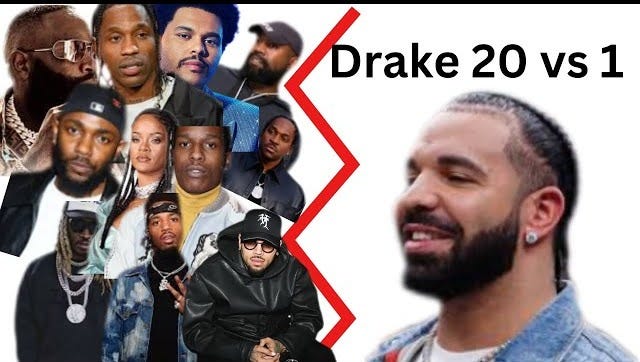
For goodness sake, even the Drake and Kendrick Lamar beef became encapsulated in a hair cut metaphor. “What is it? THE BRAIDS?”- Kendrick Lamar, Euphoria. “What is it? The braids?/ Even when I cut ‘em, I could never fade”- Drake, Make Them Remember.